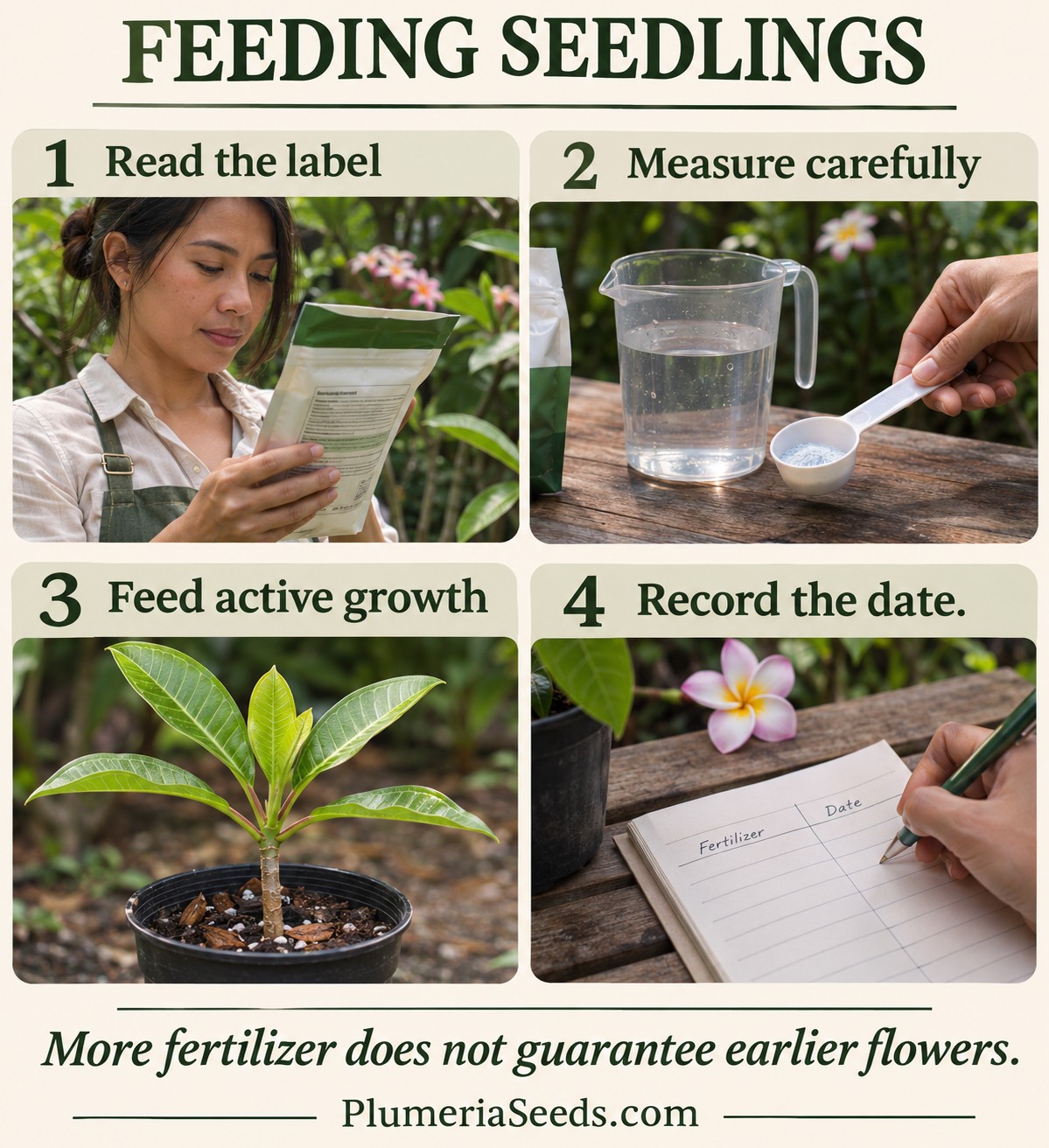
Fertilizer supplies nutrients. It cannot replace light, healthy roots, or enough time for a seedling to mature. My aim is steady growth, not the highest dose a plant can survive.
-
Count what is already in the pot
Read the potting-mix label and list every fertilizer already applied, including granular products and foliar sprays. Keep the product analysis, amount, date, and container size together.
Why: A starter charge plus granules plus repeated liquid feeds can become an unintended heavy feeding program.
-
Choose a main feeding approach
Use a complete fertilizer suited to container ornamentals, with nitrogen, phosphorus, potassium, and the needed micronutrients. Choose a controlled-release product applied at its container rate, or a measured water-soluble program. Combine them only with an intentional nutrient plan.
Why: Both approaches can work; combining full programs without accounting for each makes the total difficult to control.
-
Start with an established seedling
Look for active true-leaf and root growth and consider the nutrients already in the medium. Use the product’s young-plant rate when supplied. If only a general rate is given, ask the manufacturer about seedlings rather than applying a universal tablespoon rule.
Why: Different products have different concentrations. A dose for one fertilizer is not interchangeable with another.
-
Measure and observe
Use the labeled method and interval. Do not apply concentrated feed to severely dry or damaged roots. Review new growth, leaf margins, and drying behavior before increasing the program.
Why: Bigger doses do not fix poor uptake caused by unhealthy roots.
-
Respond to suspected excess
Pause additional feeding if decline follows an application. Check the dose and drainage. With a freely draining pot and suspected soluble-salt buildup, leaching with suitable clean water may help; ongoing release from granules may require removing accessible excess. A sodden or rotten root ball needs a different response.
Why: More fertilizer can deepen salt injury; repeated flushing of an already waterlogged pot can worsen oxygen shortage.
The products in my seven-month-bloom batch
Before transplanting, I used BioBlast 7-7-7 as a foliar spray at one tablespoon per gallon every two weeks, and Excalibur BOOST at one tablespoon per gallon of tray water, leaving the granules in the tray. At six weeks I applied two tablespoons of BOOST per one-gallon pot. These are my recorded 2024 amounts, not a universal label rate. Those amounts describe the documented early feeding program, not a complete seven-month schedule.
BioBlast supplied nutrients; BOOST provided another nutrient source. Good nutrition is a plausible contributor to sustained growth. This growing account does not provide a controlled comparison showing which product, if either, advanced flowering. Current BOOST pages show differing analyses, so match the product and directions on the actual bag rather than assuming a current formula describes my 2024 material.
What about bloom boosters and supplements?
Published guidance differs on high-phosphorus fertilizers. I would not make an extremely high middle number a requirement for flowering. Correct deficiencies, provide balanced nutrition, and address light and maturity first. Foliar feeding can supplement a program; it is not a substitute for a functioning root system. Epsom salt adds magnesium and sulfur, not a complete diet. Use it for an identified need, not as a routine flower trigger.
Related guide: Fertilizing New Plumeria Seedlings.
References: Minnesota Extension: Fertilizing and Watering Container Plants; Southern California Plumeria Society: Summer Care and Flowering; Florida Colors Nursery: Excalibur BOOST; Florida Colors Nursery: BioBlast; My 2024 Water-Tray Growing Account.