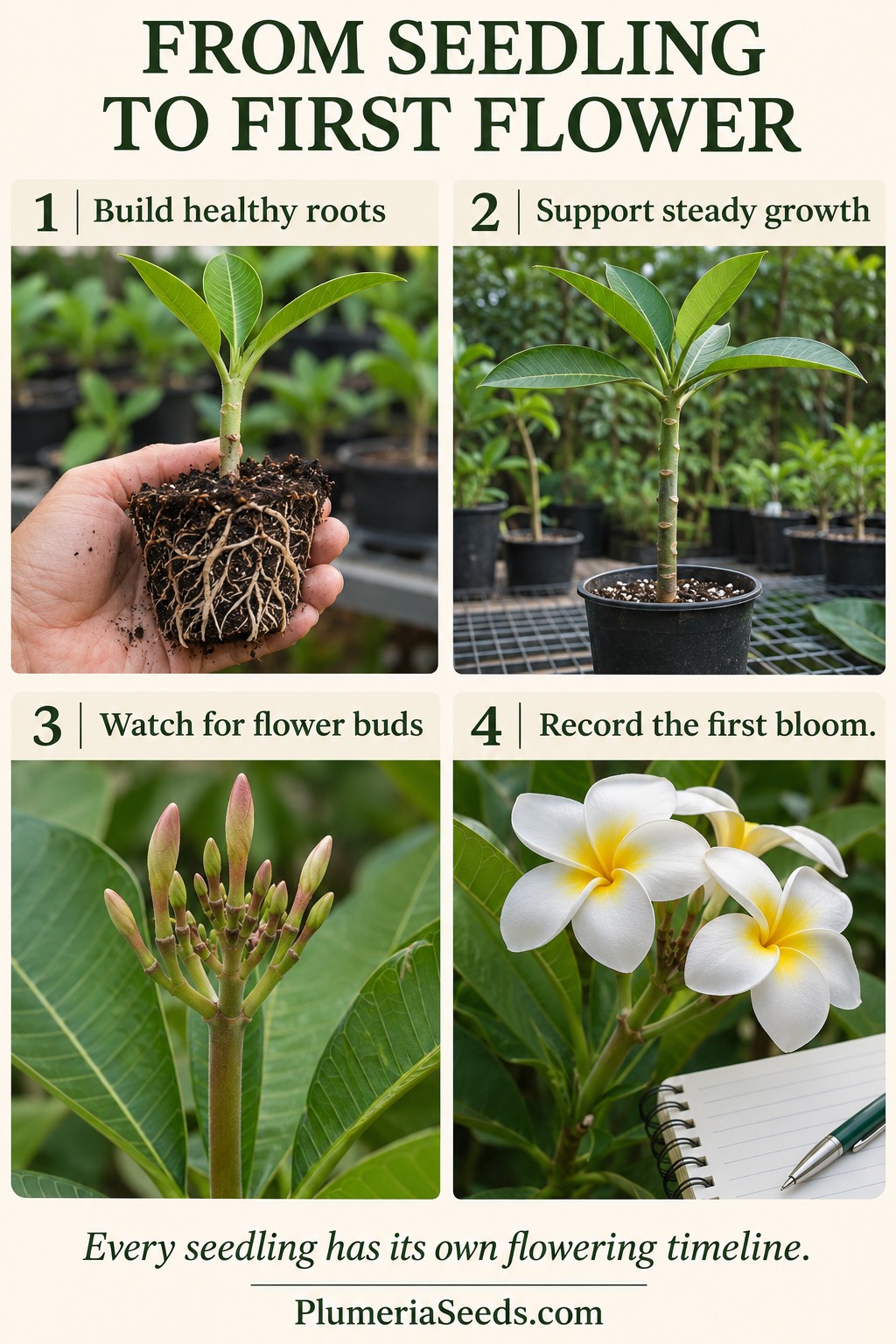
The first bloom is the reward, but the work is keeping the seedling growing well long enough to show what it can do. I would plan for years and enjoy an early flower if it comes.
Wisconsin Extension describes seed-grown plumeria as taking three or more years to flower. That is a useful expectation, not a deadline. Genetics, growing season length, light, root health, and setbacks all affect the journey.
-
Keep a continuous growing record
Keep the seedling code, seed parent, unknown or known pollen parent, sowing date, transplants, feeding, and photographs together. Record the first inflorescence separately from the first open flower.
Why: A flowering claim is more useful when someone can tell what event and starting date were measured.
-
Support steady active-season growth
Provide acclimated sunlight, root space, suitable nutrition, and water according to the pot. Pot up when the root system needs it, not whenever the top gets taller.
Why: A series of avoidable stalls makes comparison between seedlings difficult and can delay reaching maturity.
-
Protect the growing tip
Avoid routine topping merely to force a young seedling to branch or flower. If size or damage makes pruning necessary, accept that removing a tip can change the flowering schedule.
Why: Plumeria flowers develop at shoot tips. Removing potential flowering growth is not a dependable shortcut.
-
Maintain the routine when buds appear
Check moisture more carefully as the canopy grows. Avoid a sudden heavy fertilizer dose, severe drying, or a major change in exposure. Inspect buds for pests without repeatedly handling them.
Why: A visible flower stalk still has to develop; stressful changes can interrupt that process.
-
Evaluate more than one bloom
Photograph flowers with the plant code and date, record fragrance and dimensions, and keep observing later flushes. Consider branching, vigor, and flower presentation as well as color.
Why: One first flower does not fully describe the long-term plant.
What my seven-month seedling tells me
I planted seeds from Majestic in March 2024; the pollen parent was unknown. One seedling bloomed in about seven months. It was a new seedling with Majestic as its seed parent, not the named cultivar Majestic itself. The result shows what happened in that batch under my conditions. It does not establish a seven-month schedule or prove that a fertilizer caused it.
Methods I would compare, rather than promise
For a useful home trial, compare two suitable potting mixes or two label-compliant feeding approaches across several seedlings from the same pod, assigning plants without choosing only the strongest for one treatment. Keep water and light comparable, rotate positions where practical, and record losses as well as growth. Seedlings are genetically different, so one early bloomer cannot establish a winner.
I would not make drought stress, root restriction, repeated root pruning, or unverified growth-regulator treatments part of a beginner’s early-flowering plan. Grafting a seedling onto established stock is an advanced option some growers explore, but it adds skill, labeling, and comparison problems; it is not needed for this growing path or presented here as a proven way to shorten juvenility.
References: Wisconsin Extension: Plumeria; My 2024 Water-Tray Growing Account.
A routine I would use at home
- At each watering check: Look at the growing tip, assess root-zone moisture, and check that the pot can drain.
- Weekly: Inspect leaf undersides and stems, compare growth, remove fallen debris, and check labels and irrigation equipment.
- Before feeding: Read the record and product label. Check for active growth and account for fertilizer already present.
- After a change or weather event: Inspect for drying, saturation, heat, cold, or spray injury. Adjust the relevant factor instead of changing the whole program.
- At transplant and first bloom: Photograph the plant and record what actually happened.
Start earlier: Seed Germination Methods · Keep track of your seedlings · Ask a seedling-care question